Showing posts with label Albay. Show all posts

Wednesday, June 18, 2008

Albay in Google Earth

In the most recent Google Earth update last month, several towns and one city in the province of Albay now have high-resolution satellite imagery. These newly high-res areas include Ligao City, Guinobatan, Oas, Libon, Tiwi, Manito, Jovellar and Malinao. Camalig is also on high resolution but is partly hidden by clouds.

Among Albay's municipalities and cities, only Rapu-Rapu, parts of Polangui, and Pio Duran remain in low resolution. Legazpi City and Daraga first went high-res back in June 2006. The city of Tabaco and the towns of Sto. Domingo, Bacacay and Malilipot followed suit a few months later.

Browsing Google Earth is one of my favorite time wasters. Exploring both familiar and unfamiliar places through satellite imagery is what I call Google Earth sightseeing. It certainly provides a different perspective of the world around us. A great blog about Google Earth sightseeing is Vista Pinas, which features Filipino sights as seen from satellite images found in Google Earth and Google Maps.

Here are some screen grabs (click to enlarge) of newly high-res areas in Albay. Screen shots won't do justice, though. The best way to view these satellite images is through Google Earth.


Ligao City


Guinobatan


Manito

Jovellar

Tiwi

Thursday, April 17, 2008

Legazpi on SkyscraperCity's Banner

Legazpi City made it to SkyscraperCity Forum's banner for today, 17th of April 2008. SkyscraperCity, fondly called SSC by members, is a forum dedicated to architecture, development, urbanity, photography and travel with over 180,000 forum-ers from all over the globe.

SSC has a very vibrant Philippine sub-forum which has become a rich source of information about various developments in the country - from up-to-date news about upcoming skyscrapers in the Metro to spellbinding photos of unspoilt beaches and islands.

Legazpi is only the fifth city featured on SSC's banner, which changes daily. The photo, taken by Arnold Faller, is a panoramic view of Legazpi with the majestic Mayon Volcano in the background. You can view the original photo here.

Sunday, December 2, 2007

In Memoriam

November 30 will perhaps be forever etched in the hearts of all Albayanos as a day of immense tragedy and unprecedented destruction. Hundreds of people lost their lives that day, and even more saw their homes either partially or totally destroyed. Billions of pesos worth of property and agricultural crops were laid to waste as Reming swept through the province with 265 kph winds and torrential rains that induced lethal mudflows from Mayon's flanks.

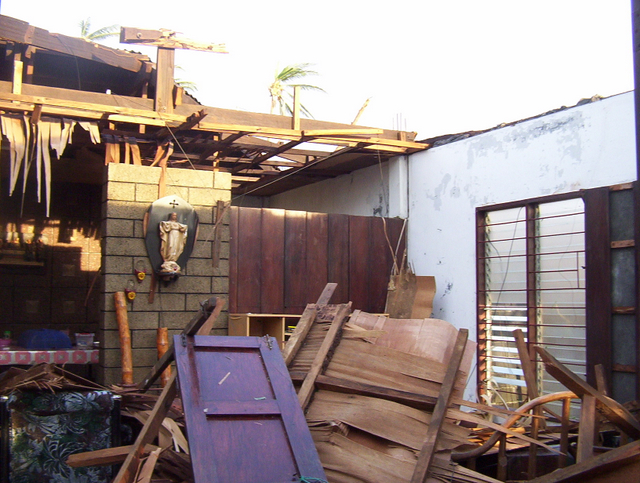
Although our residence is not prone to floods, we also bore the full brunt of that supertyphoon. Our house was in ruins. Extremely strong winds brutally ripped the roof off of almost 1/2 of our house and flung the heavy timber and G.I. sheets a few hundred meters away. As the typhoon raged outside, all seven of us in the family cowered for almost 6 hours inside the bathroom fearing the worst and praying for the storm to end. The horrible, endless roar of the typhoon's raw power is one sound we probably can never forget.

Our living room, the morning after the typhoon

I still get goosebumps whenever I watch the video clips I took that day. Because I know that at the same time I was filming the typhoon's effects on our vicinity with my digital camera, hundreds were either dying or already dead in neighboring villages and towns, trapped under dark raging waters mixed with volcanic sand, boulders and debris.

But the winds died down, the rain stopped, and the sun shone again from behind the clouds. Now, one year later, my city and my province are back on their feet and still moving forward, displaying the admirable resilience that makes me proud to be an Albayano.

Here at home, a new glistening Christmas tree now stands in our living room, the same area that was destroyed by the typhoon. It is a symbol of hope and gratitude. After experiencing the worst Christmas ever last year, one appreciates more even simple things such as Christmas lights and tinsels.

I am thankful that we survived that huge calamity (although our favorite pet dog didn't) and I am praying that God's providence will protect us from future harm.

This post is in memory of the almost 1,000 victims of Typhoon Reming. May they find peace, warmth and comfort in the company of our Lord in Heaven.

Thursday, October 25, 2007

Legazpi’s Embarcadero On the Rise

Bird's Eye view of Embarcadero

A few months ago, I wrote about Legazpi City’s newest world-class destination on the rise – the Embarcadero, an ambitious project spearheaded by Misibis Land Inc. (MLI). Now, MLI’s latest official newsletter, Misibis Today, reveals more details about this Marina-inspired development in the Legazpi Port area. Construction of Phase I (which already cost P450-500 million) is now in full swing and is expected to be completed next year.

Master-planned by BN Group Pty of Australia, the Embarcadero will have a total of nine structures within the 2.5 hectare site, including a four-level commercial and lifestyle center that will house specialty shops, restaurants, bars, a supermarket and an 800-seat call center, among others. Six other structures ranging from 1 to 2 storeys each will be spread out across the site located at the foot of the Kapuntukan or Sleeping Lion Hill.

The entire complex will be punctuated by a 30-meter, intricately-designed steel and concrete lighthouse that will undoubtedly become a new landmark for Legazpi. Since I happen to love lighthouses, I can’t wait to see how this new modernistic structure will turn out. Closer inspection of the architectural renderings reveal a possible spiral staircase within the structure that could lead to an observation deck at the top. This will undoubtedly provide a breathtaking panorama of Legazpi, Mayon Volcano and the wide expanse of the Albay Gulf.

Celebration Plaza and Lighthouse

An expansive civic space amidst the structures will be called the Celebration Plaza. Aside from the lighthouse, the plaza will be the centerpiece of the Embarcadero and will provide a venue for conventions, concerts, expos, trade fairs and other events. The wooden boardwalk furnished with benches, food stalls, and kiosks will provide Legazpeños and tourists with a place for relaxing, strolling, biking, simply enjoying the sea breeze and other activities.

Meanwhile, to address concerns about safety, with the city being on the typhoon belt, the company made sure the waterfront facility has typhoon-resistant buildings and will be elevated from the natural ground line. The bay walk will also serve as an elevated and inclined seawall. Also, Phase III of the project requires reclamation of about 500 meters of the shoreline which will surely widen the land area for the facility.

Majority of Legazpeños are not yet aware that such a project is now being built in an area that once had a bad reputation as a place for brawls and pickpockets. With the recent disasters, some are even doubtful of the safety of building a waterfront structure. Still, I think we can expect that MLI, being a genuine Bicolano company, fully understands the safety needs and will implement measures to protect their multi-million peso investment.

Shops and Restaurants within Embarcadero

I hope the success of this project will have a ‘ripple effect’ throughout the entire city and help boost its economy and rejuvenate the port district. This project may be ambitious but it certainly is not quixotic. I wish other sectors of the Legazpi community will be as audacious and forward-looking as MLI.

Photos from the Misibis Today Newsletter, July 2007 Edition (click to enlarge)
For construction photos and more updates click here.

Wednesday, August 15, 2007

Embarcadero in Legazpi City

Citizens of Legazpi will soon have another prime destination right within the city – the Embarcadero. Formerly called Sunwest Wharf, the Embarcadero is a project of Misibis Land Inc, the developer of Misibis Resorts, Estates and Spas. This wharf development will be located in the Legazpi Port Area near the unique Kapuntukan Hill (also called the Sleeping Lion because of its shape).

The Embarcadero is a waterfront project that is envisioned to be a new world-class destination for local and international tourists with retail areas, restaurants, a civic space and a landmark lighthouse. Embarcadero will be designed by BN Group Pty Ltd, an Australian-based architectural and urban design firm which is also involved with the Suria KLCC Retail Podium in KL, Malaysia and the East Darling Harbour in Sydney.

As its name implies, Embarcadero will not just be a destination in itself but will also be a jump-off point to other destinations within Bicol including Mayon Volcano, Vera Falls in Malinao, Sula Channel, the underground river of Pototan Cave, the giant Manta rays of Ticao Pass, the whalesharks of Donsol , Nag-aso Boiling Lake of Manito, Camarines Sur Watersports Complex and Misibis Resorts, Estates and Spas. The company is already looking for a Marketing Manager for the retail area.

I hope this new development in Legazpi City will be successful and will win the support of Legazpeños and Albayanos. Along with other projects such as the Southern Luzon International Airport in Daraga and the rehabilitation of the mothballed Mayon International Hotel, these developments can further spur tourism here in our province.

Eco-tourism can do wonders to our local economy and will certainly create more jobs and business opportunities. Now that the private sector is doing its part by investing in our own natural wonders, I hope every Albayano will also do their part in making our place more tourist-friendly and progressive.

Sometimes the problem lies not only in the lack of infrastructure or the lack of government funding but also in the cynical attitude of some.

Sadly, many of our kababayans do not give a damn about their own city and province. We need 'pride of place', belief in the beauty of our natural resources and our capability for progress despite whatever problems and disasters. The site of the Embarcadero may not look promising at present, but it takes people with vision and determination to create progress and change. If we work together, nothing is impossible.

Tuesday, August 14, 2007

A Glimpse of Old Cagsawa

The ruins of Cagsawa Church in Daraga, Albay never fails to enthrall me even if I've stood under its austere presence for dozens of times already. For 193 years, the ruins remain as a silent reminder of the lethal fury of Bicol's femme fatale, Mayon Volcano. Over a thousand people died there after a deadly lahar swept through the town, a terrible precursor to more recent tragedies.

I have always wondered how the once-flourishing pueblo of Cagsawa looked like. What were the structures built in and around the town? Were there plazas and teeming markets with fresh produce coming in from the seaside pueblos of Legazpi or the wide, arable plains of Ambos Camarines? What was life like in 19th century Cagsawa or Budiao?

With very little recorded information, and virtually no paintings nor photographs to provide a visual clue to what Cagsawa must have been, that town now lives only in our imagination.

As for the church of Cagsawa, I came across a rare photograph of an apparently intact church, with the belfry and part of the main building still standing amidst what looks like a rocky wasteland overgrown with weeds. Of course, this photo couldn't have been taken before the eruption in 1814 because photography was not yet developed as a usable process back then. In fact the oldest photograph in the world dates back only to 1826 or a full twelve years after Cagsawa was buried by lahar.

This remarkable photo provides a glimpse of how Cagsawa church looked like in the 19th century. I think it has a bit of a resemblance to the present church of Camalig, doesn't it? The only distinct difference is the shape of the belfry: Cagsawa has a more pointed top while the one in Camalig is rounder. I'm just wondering what happened to the other parts of the church, particularly the main building. Did it crumble away leaving only the belfry, standing like an old grey tombstone amidst the greenery? Was it torn down by relic hunters?

I can only guess.

For now, we still have Cagsawa's ancient belfry to behold, still standing like a sentinel even as modern catastrophes have dealt hard blows upon our land once in a while. It is a silent reminder of our past and a grim warning of what the future may hold.

To see photos of the present Cagsawa Ruins, click here
Old Cagsawa Photo credit to Jed Llamas, DigitalPhotographer.com.ph
More information at the Albay Tourism Website

Saturday, February 10, 2007

Road Trip to Joroan

Last Sunday, February 4, I and my colleagues and friends went on a road trip to the town of Tiwi, a 45-minute drive north of Legazpi City. The group attended mass at the old town church and later indulged in the famous Tiwi halo-halo. The halo-halo of Tiwi is quite popular because of the softer consistency of the shaved ice which makes it creamier and smoother. There's also a generous heap of cheese on top. And since I'm a bit of a cheese lover, that's fine with me.

After lunch, the group decided to head for the scenic road going to Joroan, a barangay of Tiwi famous for being the home of the Nuestra Señora de Salvacion, a revered and miraculous Marian image. The Hanging Road to Joroan is called as such because it winds its way up, with the mountain at one side and a steep cliff diving down into the sea on the other. The view overlooking the blue-green Lagonoy Gulf was spectacular. One can even see the island province of Catanduanes in the distance.

Of course the best part of the road trip was the company, any trip with these guys is always laugh trip!

Check out some photos of Joroan after the jump.


You can also check out my Flickr for higher resolution photos. :-)

Albay in Google Earth

In the most recent Google Earth update last month, several towns and one city in the province of Albay now have high-resolution satellite i...